Showing posts with label Honda. Show all posts

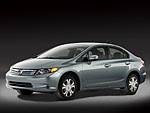
2012 HONDA Civic

Click Thumbnail to download (size 1600 x 1200 pixels)


Featuring the widest array of engine choices available in its class, the 2012 Honda Civic is designed to even better meet the diverse needs of the compact-vehicle buyer when it launches in the spring of 2011. The entire redesigned ninth-generation Civic lineup will become more fuel efficient with two models - the all-new Honda Civic HF and the Civic Hybrid - each delivering fuel economy estimates of more than 40 mpg on the highway.

Built on the tradition of Honda fuel efficiency, the economical Honda Civic HF model will be the most fuel-efficient gasoline-only powered Civic in the lineup when it launches this spring. Equipped with a 1.8-liter i-VTEC engine, the Honda Civic HF is targeted to earn EPA-estimated fuel economy of 41 mpg on the highway. The 2012 Civic Hybrid, which will be outfitted for the first time with a lithium-ion battery and a larger 1.5-liter i-VTEC engine, is expected to achieve an EPA-estimated city/highway combined fuel economy of 45 mpg, an improvement of 4 mpg compared to the current Civic Hybrid. Both the Honda Civic HF and Civic Hybrid models will be equipped with aerodynamic components for improved efficiency and Honda ECO Assist™ technology, an innovation that can enhance efficient vehicle operation while providing feedback to promote more efficient individual driving styles.

"The Civic is the only model in the industry that can deliver on all fronts - fuel economy, sporty performance, smart packaging, alternative fuel and long-term value," said John Mendel, executive vice president of sales for American Honda Motor Co.,Inc. "For the ninth-generation Civic, we are emphasizing improved fuel economy across the board, from the hybrid sedan to the sporty Si model."

In addition to the Honda Civic HF and Civic Hybrid models, the Civic Sedan, Civic Coupe and Civic GX Natural Gas models are also estimated to achieve improved fuel economy compared to the current models. The Honda Civic Sedan and Civic Coupe achieve an EPA-estimated fuel economy of 39 mpg on the highway, an improvement of 3 mpg when compared to the current model. The Civic Natural Gas vehicle is anticipated to earn a 7 percent improvement in fuel economy compared to the current model. The Civic Sedan, Civic Coupe and Civic Natural Gas models will all be equipped with the Honda ECO Assist technology.

Along with improved fuel economy, the new Honda Civic lineup also delivers more performance, particularly with the Civic Si. The Civic Si sedan and coupe models will be equipped with a larger, more powerful 2.4-liter engine as well as a new 6-speed manual transmission. The new engine is anticipated to deliver 200 horsepower with 170 ft-lb of torque. Even with the larger engine and a 22 percent increase in torque, Civic Si is targeted to achieve an EPA-estimated highway fuel economy of 31 mpg; an increase of 2 mpg when compared to the current model.

The 2012 Civic lineup includes a sedan and a coupe with conventional gasoline models, a new "HF" high fuel economy version, two sporty "Si" performance versions, along with one hybrid and a natural gas alternative-fuel variant.

Honda Civic CVCC, 1975

Honda Civic CVCC, 1975


The Honda Civic is an automobile manufactured by Honda. It was introduced in July 1972 as a two-door coupe, followed by a 3-door hatchback version that September. With the transverse engine placement of its 1169 cc engine and front wheel drive, like the British Mini, the car provided good interior space despite overall small dimensions.

Early models of the Civic were typically outfitted with a basic AM radio, rudimentary heater, foam cushioned plastic trim, two-speed wipers, and painted steel rims with a chromed wheel nut cap. The current Civic has become much more luxurious with satellite-linked navigation, a six-speed manual, power locks and power windows available. Still, many regard the Civic as representing a good value for the money, combining good performance, reliability and economy, as well as a very low rate of depreciation.

The Civic evolved from having a 1170 cc engine (1973) to having engines with larger capacities and more creature comforts (air conditioning, power windows, etc.) through the 1980s, 1990s and into the 2000s.

First generation (1973-1979)
The original 1973 Civic had a wheelbase under 87 inches and an overall length of 140 inches

Initially the Civic was sold with either a four-speed manual or a two speed "HondaMatic" model. Later models went to a five-speed manual and a full four-speed automatic transmission. Like the Mini, the transaxle was integrated with the engine unit.

Second generation (1979-1983)
The second generation Civic had a new, sleeker body and increased wheelbase to 88.6 inches for the hatchback and 91.3 inches for the wagon. The two-door sedan was no longer produced. All engines was now of the CVCC design ranging from 1335 cc giving 55 hp to 1488 cc giving 67 hp. The transmission was either a four-speed manual, a five-speed manual or a two-speed automatic. In 1981 a four door sedan was introduced and the two-speed automatic gearbox was replaced by a three speed. In 1982 it was slightly restyled with rectangular headlamps and black bumpers. In 1983 the sportier Civic S replaced the 1500GL.

Third generation (1983-1987)
For the third generation the wheelbase was increased by 5 inches to 96.5 inches. A new 12 valve (three valves per cylinder) 76 hp 1500 cc engine was introduced. The base hatchback still used the 1300 cc engine giving 60 hp. Supension was updated to independent rear suspension. The CRX was a Civic with a slightly different body. In 1985 the CRX Si was introduced. It came with a fuel-injected version of the 1500 cc engine giving 91 horsepower. In 1986 the Civic got flush-mounted headlights. Other news for the year was a four-speed automatic and an Si version of the Civic hatchback.

Fourth generation (1987-1991)
Again the wheelbase was increased to 98.4 inches. The body was designed with lower hood line and more glass giving less drag. The Civics also got a new family of engines. A 1500 cc 16-valve engine giving 92 hp was used in the DX hatchback/sedan, new LX sedan and the wagon. The base hatchback had a 70 hp version of the same engine. All engines were fuel injected. All wheels had double-wishbone suspension. In 1990 the EX trim was introduced.

Fifth generation (1991-1995)
The fifth generation had a more wedge shaped body and the wheelbase was increased to 101.3 inches for the two-door hatchback and 103.2 inches for the four-door sedan. The wagon was also dropped.

Sixth generation (1996-2000)
Beginning in 1997, Honda produced the first iteration of Civic to receive the "Type-R" appellation (applied first to the Integra Type-R), with the EK9 chassis Civic Type-R. The EK9-generation Civic Type-R had a maximum output in the range of 180 PS JIS (177 hp/132 kW), increased over the more common 160 PS (158 hp/118 kW) B16A engine in the SiR/VTi models, and included various alterations to the chassis to improve handling and reduce weight (such as better welding of the frame, and removal of the radio and noise-suppressing materials).

Seventh generation (2001-2005)
In 2001, Honda announced the release of the Civic Type-R for the EP chassis, a more sporty variant of the most recent model of Civic and successor to the EK9 Civic Type-R. Unlike the EK9 version, which was produced solely in Japan, the EP Civic Type-R is produced in the United Kingdom and exported to Japan. The EP Civic Type-R has a specific output of 200 PS (197 hp/147 kW) at 8000 rpm, a six-speed manual transmission, a reworked exterior with a bullet-like hatchback design, aeroform bumpers, spoiler, and 17 in wheels. The interior of the Type-R includes Recaro seats and a Momo steering wheel, and the model also includes Type-R-specific badging, a helical limited-slip differential, and has been reported to accelerate from zero to 60 mph in about 6.6 seconds (6.4 in facelifted model).

The hybrid version became available in 2003, which uses both a small (1.3 L) main gasoline engine and auxiliary electric motors. The electric motors are powered by a battery array which is charged by regenerative braking during deceleration, which reduces exhaust emissions and extends fuel mileage.

The new Sport Hatchback model with futuristic styling was unveiled in August 2005 for the European market only. This model featured from launch a 1.4 L I-DSI and a 1.8 L i-VTEC rated at 83 PS (81 hp/61 kW) and 140 PS (138 hp/103 kW) respectively, with 177 and 207 km/h (110 and 129 mph) top speeds and 14.2 and 8.6 sec 0-100 km/h sprint. The Sport Hatchback is also available with a 2.2 L I-CTDI Diesel engine from the Accord, Edix/FR-V and CR-V, rated at 140 PS (138 hp/103 kW) and is capable of 205 km/h (127 mph) and accelerating from 0-60 mph in 8.4 seconds.
 

Honda AZ-600, 1971

Honda AZ-600, 1971


Honda AZ-600, 1971

Honda N600, 1967

Honda N600, 1967


The N600 was introduced in 1969. It was technologically advanced for its time, with an all alloy engine which could achieve 9000 rpm. Engine output was 36–45 hp (27–34 kW) and the N600 was capable of 81 mph (130 km/h). It delivered surprisingly peppy performance because of its light weight (around 550 kg/1100 pounds), due to compact dimensions and some plastic parts (like the boot lid). The first brakes were very weak. Rear suspension was a torsion bar and leaf springs. Production was stopped in 1972, after the sportier Honda Z600 (or Z-Act, depending on country) was introduced.

HONDA Civic Concept (2011)

Click Thumbnail to download (size 1600 x 1200 pixels)


The Honda Civic Si Concept coupe and Honda Civic Concept sedan made their world debuts at the 2011 North American International Auto Show, providing the first official glimpse at the styling direction of the all-new, ninth-generation 2012 model set to go on sale this spring, the company announced.

"The Civic is known for providing a balance of 'just-right' packaging, fun-to-drive character and outstanding fuel economy, at a price that even first-time buyers can afford," said John Mendel, executive vice president of sales for American Honda. "The redesigned Civic builds on this legacy and promises to be the best Civic yet."

The 2012 Civic embraces the company's vision as a "Civic for all people," a phrase originally expressed in defining the goal of the first-generation Civic. With the widest array of engine choices available in its class, the 2012 Civic lineup intends to meet the needs of an increasing group of compact-vehicle buyers with a renewed vision of a "Civic for all people." The diverse vehicle range includes a sedan and a coupe with conventional gasoline models, two sporty "Si" performance versions, along with one hybrid and a natural gas alternative-fuel variant. Collectively the depth of the Civic line offers a compelling balance between fuel economy, low emissions and fun-to-drive performance unlike any other vehicle in the industry.

As a new interpretation of the current Civic's iconic "one-motion" mono-form shape, the upcoming, ninth-generation Civic conveys a more substantial, high-energy appearance. The exterior styling of both Honda Civic concept models showcases the sedan's and coupe's clean-yet-powerful lines with steeply raked windshields, wide stances and pronounced character lines along the profile. The lower character line on both models broadens toward the rear fenders to enhance the dynamic feeling of forward energy. The front fender surface treatments form a complex, three-dimensional look to further enhance the image of sophistication and structural depth against the deeply set headlights.

The Honda Civic Concept sedan takes on a sophisticated presence with a front grille defined by crisp lines and a solid bar that integrates a chrome Honda emblem. The look of the Honda Civic Si Concept coupe conveys an aggressive demeanor with a more angular front fascia, mesh grille and a tapered rear roofline that flows smoothly into the trunk. The Honda Civic Si Concept coupe is exclusively equipped with a rear air diffuser, a center-mounted exhaust outlet and a rear deck lid spoiler with dual vents. Each concept model has 19-inch machined alloy wheels.

Powertrain Technology

The Civic's family of engines with "intelligent" Variable Valve Timing and Lift Electronic Control (i-VTEC®) technology become even more fuel efficient for 2012. The upcoming Civic Hybrid offers the latest generation of the compact and lightweight Integrated Motor Assist™ (IMA™) gasoline-electric hybrid system and features the first application of a lithium-ion battery in a Honda hybrid.

Building on its emphasis on fuel-economy, most upcoming Civic models receive Honda Eco Assist™ technology, already available in the CR-Z and Insight hybrids. The 2012 Civic is the first U.S. Honda model to employ Eco Assist technology in a gasoline-only powered vehicle. Eco Assist is just one example of how the new Civic can be customized and configured by the drivers to suit individual preferences.

Additionally, Honda is expanding retail sales of the natural gas-powered Civic GX model, which is the only OEM-built, dedicated CNG passenger car assembled in America. The increased availability of the Civic GX helps bring inherently clean-burning natural gas technology to an even broader audience while also supporting diversity in transportation energy resources.

Safety

The 2012 Civic continues to emphasize safety and is anticipated to score well in both the federal government's New Car Assessment Program (NCAP) and the Insurance Institute for Highway Safety (IIHS) vehicle evaluations. The 2001 Honda Civic Coupe was one of the first two passenger cars ever to earn the federal government's top 5-star crash safety rating for the driver and front- and rear-seat passengers in both frontal and side-impact crash tests.

All 2012 Civics are equipped with Vehicle Stability Assist™ (VSA®) as standard equipment. Additionally, the ninth-generation Civic continues to provide Honda's exclusive and innovative Advanced Compatibility Engineering™ (ACE™) body structure for frontal collision energy management.

HONDA Civic Si Concept (2011)

Click Thumbnail to download (size 1600 x 1200 pixels)


The Honda Civic Si Concept coupe and Honda Civic Concept sedan made their world debuts at the 2011 North American International Auto Show, providing the first official glimpse at the styling direction of the all-new, ninth-generation 2012 model set to go on sale this spring, the company announced.

"The Civic is known for providing a balance of 'just-right' packaging, fun-to-drive character and outstanding fuel economy, at a price that even first-time buyers can afford," said John Mendel, executive vice president of sales for American Honda. "The redesigned Civic builds on this legacy and promises to be the best Civic yet."

The 2012 Civic embraces the company's vision as a "Civic for all people," a phrase originally expressed in defining the goal of the first-generation Civic. With the widest array of engine choices available in its class, the 2012 Civic lineup intends to meet the needs of an increasing group of compact-vehicle buyers with a renewed vision of a "Civic for all people." The diverse vehicle range includes a sedan and a coupe with conventional gasoline models, two sporty "Si" performance versions, along with one hybrid and a natural gas alternative-fuel variant. Collectively the depth of the Civic line offers a compelling balance between fuel economy, low emissions and fun-to-drive performance unlike any other vehicle in the industry.

As a new interpretation of the current Civic's iconic "one-motion" mono-form shape, the upcoming, ninth-generation Civic conveys a more substantial, high-energy appearance. The exterior styling of both Honda Civic concept models showcases the sedan's and coupe's clean-yet-powerful lines with steeply raked windshields, wide stances and pronounced character lines along the profile. The lower character line on both models broadens toward the rear fenders to enhance the dynamic feeling of forward energy. The front fender surface treatments form a complex, three-dimensional look to further enhance the image of sophistication and structural depth against the deeply set headlights.

The Honda Civic Concept sedan takes on a sophisticated presence with a front grille defined by crisp lines and a solid bar that integrates a chrome Honda emblem. The look of the Honda Civic Si Concept coupe conveys an aggressive demeanor with a more angular front fascia, mesh grille and a tapered rear roofline that flows smoothly into the trunk. The Honda Civic Si Concept coupe is exclusively equipped with a rear air diffuser, a center-mounted exhaust outlet and a rear deck lid spoiler with dual vents. Each concept model has 19-inch machined alloy wheels.

Powertrain Technology
The Civic's family of engines with "intelligent" Variable Valve Timing and Lift Electronic Control (i-VTEC) technology become even more fuel efficient for 2012. The upcoming Civic Hybrid offers the latest generation of the compact and lightweight Integrated Motor Assist (IMA) gasoline-electric hybrid system and features the first application of a lithium-ion battery in a Honda hybrid.

Building on its emphasis on fuel-economy, most upcoming Civic models receive Honda Eco Assist™ technology, already available in the CR-Z and Insight hybrids. The 2012 Civic is the first U.S. Honda model to employ Eco Assist technology in a gasoline-only powered vehicle. Eco Assist is just one example of how the new Civic can be customized and configured by the drivers to suit individual preferences.

Additionally, Honda is expanding retail sales of the natural gas-powered Civic GX model, which is the only OEM-built, dedicated CNG passenger car assembled in America. The increased availability of the Civic GX helps bring inherently clean-burning natural gas technology to an even broader audience while also supporting diversity in transportation energy resources.

Safety
The 2012 Civic continues to emphasize safety and is anticipated to score well in both the federal government's New Car Assessment Program (NCAP) and the Insurance Institute for Highway Safety (IIHS) vehicle evaluations. The 2001 Honda Civic Coupe was one of the first two passenger cars ever to earn the federal government's top 5-star crash safety rating for the driver and front- and rear-seat passengers in both frontal and side-impact crash tests.

All 2012 Civics are equipped with Vehicle Stability Assist (VSA) as standard equipment. Additionally, the ninth-generation Civic continues to provide Honda's exclusive and innovative Advanced Compatibility Engineering (ACE) body structure for frontal collision energy management.

Honda Civic, 1973

Honda Civic, 1973


The Honda Civic is an automobile manufactured by Honda. It was introduced in July 1972 as a two-door coupe, followed by a 3-door hatchback version that September. With the transverse engine placement of its 1169 cc engine and front wheel drive, like the British Mini, the car provided good interior space despite overall small dimensions.

Early models of the Civic were typically outfitted with a basic AM radio, rudimentary heater, foam cushioned plastic trim, two-speed wipers, and painted steel rims with a chromed wheel nut cap. The current Civic has become much more luxurious with satellite-linked navigation, a six-speed manual, power locks and power windows available. Still, many regard the Civic as representing a good value for the money, combining good performance, reliability and economy, as well as a very low rate of depreciation.

The Civic evolved from having a 1170 cc engine (1973) to having engines with larger capacities and more creature comforts (air conditioning, power windows, etc.) through the 1980s, 1990s and into the 2000s.

First generation (1973-1979)
The original 1973 Civic had a wheelbase under 87 inches and an overall length of 140 inches

Initially the Civic was sold with either a four-speed manual or a two speed "HondaMatic" model. Later models went to a five-speed manual and a full four-speed automatic transmission. Like the Mini, the transaxle was integrated with the engine unit.

Second generation (1979-1983)
The second generation Civic had a new, sleeker body and increased wheelbase to 88.6 inches for the hatchback and 91.3 inches for the wagon. The two-door sedan was no longer produced. All engines was now of the CVCC design ranging from 1335 cc giving 55 hp to 1488 cc giving 67 hp. The transmission was either a four-speed manual, a five-speed manual or a two-speed automatic. In 1981 a four door sedan was introduced and the two-speed automatic gearbox was replaced by a three speed. In 1982 it was slightly restyled with rectangular headlamps and black bumpers. In 1983 the sportier Civic S replaced the 1500GL.

Third generation (1983-1987)
For the third generation the wheelbase was increased by 5 inches to 96.5 inches. A new 12 valve (three valves per cylinder) 76 hp 1500 cc engine was introduced. The base hatchback still used the 1300 cc engine giving 60 hp. Supension was updated to independent rear suspension. The CRX was a Civic with a slightly different body. In 1985 the CRX Si was introduced. It came with a fuel-injected version of the 1500 cc engine giving 91 horsepower. In 1986 the Civic got flush-mounted headlights. Other news for the year was a four-speed automatic and an Si version of the Civic hatchback.

Fourth generation (1987-1991)
Again the wheelbase was increased to 98.4 inches. The body was designed with lower hood line and more glass giving less drag. The Civics also got a new family of engines. A 1500 cc 16-valve engine giving 92 hp was used in the DX hatchback/sedan, new LX sedan and the wagon. The base hatchback had a 70 hp version of the same engine. All engines were fuel injected. All wheels had double-wishbone suspension. In 1990 the EX trim was introduced.

Fifth generation (1991-1995)
The fifth generation had a more wedge shaped body and the wheelbase was increased to 101.3 inches for the two-door hatchback and 103.2 inches for the four-door sedan. The wagon was also dropped.

Sixth generation (1996-2000)
Beginning in 1997, Honda produced the first iteration of Civic to receive the "Type-R" appellation (applied first to the Integra Type-R), with the EK9 chassis Civic Type-R. The EK9-generation Civic Type-R had a maximum output in the range of 180 PS JIS (177 hp/132 kW), increased over the more common 160 PS (158 hp/118 kW) B16A engine in the SiR/VTi models, and included various alterations to the chassis to improve handling and reduce weight (such as better welding of the frame, and removal of the radio and noise-suppressing materials).

Seventh generation (2001-2005)
In 2001, Honda announced the release of the Civic Type-R for the EP chassis, a more sporty variant of the most recent model of Civic and successor to the EK9 Civic Type-R. Unlike the EK9 version, which was produced solely in Japan, the EP Civic Type-R is produced in the United Kingdom and exported to Japan. The EP Civic Type-R has a specific output of 200 PS (197 hp/147 kW) at 8000 rpm, a six-speed manual transmission, a reworked exterior with a bullet-like hatchback design, aeroform bumpers, spoiler, and 17 in wheels. The interior of the Type-R includes Recaro seats and a Momo steering wheel, and the model also includes Type-R-specific badging, a helical limited-slip differential, and has been reported to accelerate from zero to 60 mph in about 6.6 seconds (6.4 in facelifted model).

The hybrid version became available in 2003, which uses both a small (1.3 L) main gasoline engine and auxiliary electric motors. The electric motors are powered by a battery array which is charged by regenerative braking during deceleration, which reduces exhaust emissions and extends fuel mileage.

The new Sport Hatchback model with futuristic styling was unveiled in August 2005 for the European market only. This model featured from launch a 1.4 L I-DSI and a 1.8 L i-VTEC rated at 83 PS (81 hp/61 kW) and 140 PS (138 hp/103 kW) respectively, with 177 and 207 km/h (110 and 129 mph) top speeds and 14.2 and 8.6 sec 0-100 km/h sprint. The Sport Hatchback is also available with a 2.2 L I-CTDI Diesel engine from the Accord, Edix/FR-V and CR-V, rated at 140 PS (138 hp/103 kW) and is capable of 205 km/h (127 mph) and accelerating from 0-60 mph in 8.4 seconds.

Honda AZ600, 1971

Honda AZ600, 1971


Honda AZ600, 1971

Honda N600, 1967

Honda N600, 1967


The N600 was introduced in 1969. It was technologically advanced for its time, with an all alloy engine which could achieve 9000 rpm. Engine output was 36–45 hp (27–34 kW) and the N600 was capable of 81 mph (130 km/h).

It delivered surprisingly peppy performance because of its light weight (around 550 kg/1100 pounds), due to compact dimensions and some plastic parts (like the boot lid). The first brakes were very weak. Rear suspension was a torsion bar and leaf springs. Production was stopped in 1972, after the sportier Honda Z600 (or Z-Act, depending on country) was introduced.

Honda S600, 1964

Honda S600, 1964


Honda S600, 1964

HONDA HSV-010 GT (2010)

Click Thumbnail to download (size 1600 x 1200 pixels)


Honda HSV-010 GT

Technical Specifications

* Dimensions
o Length: 4675 mm
o Width: 2000 mm
o Vehicle weight: 1100+ kg
* Engine
o Engine name: HR10EG
o Configuration: Liquid-cooled, naturally aspirated, longitudinal V8
o V angle: 90°
o Valve train: Gear-driven DOHC - 2 intake and 2 exhaust valves per cylinder
o Displacement: 3397 cm3
o Bore x stroke: 93.0 x 62.5 mm
o Maximum output: 500 PS (370 KW)
o Maximum torque: 392 Nm
o Throttle control system: Mechanical
o Fuel supply system: Programmed fuel injection system (Honda PGM-FI)
o Fuel: Lead-free premium gasoline
o Lubrication: Dry sump
* Powertrain
o Transmission mechanism: Constant mesh
o Transmission shifting method: Steering paddle shifter
o Steering system mechanism: Rack and pinion system with electric power steering (EPS)
* Tires
o front: 330/40R18
o rear: 330/45R17
* Brake type and mechanism: Hydraulic ventilated disc system
* Suspension system: Double wishbone
* Stabilizer: Torsion bar

HONDA Accord (2011)

Click Thumbnail to download (size 1600 x 1200 pixels)


Set to go on sale in mid-August of 2010, the 2011 Honda Accord Sedan and Coupe receive significant updates including improved fuel economy, enhanced exterior and interior styling and the addition of a new leather-equipped Special Edition (SE) trim level. Available as either a sedan or a coupe in 4-cylinder and V6 variations, the Honda Accord offers a unique balance of style, performance, efficiency and value specific to each individual model.
 
"For 2011, the Honda Accord evolves again with sharpened styling inside and out, fuel economy gains and a broader application of popular features," said Erik Berkman, vice president of Corporate Planning and Logistics for American Honda Motor Co., Inc. "The Honda Accord is designed to deliver a consistently rewarding ownership experience in the areas that matter most to sedan and coupe drivers."

Improvements to vehicle aerodynamics, engine friction and transmission gear ratios all contribute to fuel economy improvements. The EPA fuel-economy ratings for Honda Accord 4-cylinder sedan models equipped with an automatic transmission improve by 2 miles per gallon (mpg) in the city and 3 mpg on the highway, for a city/highway rating of 23/34 mpg.The 2011 Honda Accord Sedan's exterior expresses a more upscale and powerful presence with a new style for the front grille, front bumper and rear deck lid, along with a new wheel design.

Building on the sedan's design character, the Honda Accord Coupe's unique muscular stance is enhanced with a bolder front grille design, new front bumper shape, enhanced brakelight appearance and a new wheel design for V6 models.

Striking a balance between value and luxury, the Honda Accord SE Sedan offers the additional features from the popular Honda Accord LX-P with the added luxury of leather-trimmed seating, heated seats, driver's power-lumbar support and a leather-trimmed steering wheel.

New features on certain models include steering wheel-mounted paddle shifters on the Honda Accord EX-L V6 Coupe, a USB Audio Interface on all coupe models and Honda Accord EX and EX-L Sedans, and a rear view camera on sedans equipped with the available Honda Satellite-Linked Navigation System™. Additionally, Honda Accord EX-L V6 models receive a two-position memory system for the driver's seat. Additional interior updates on all models include new seat fabrics on models with cloth seats, an updated instrument panel design and more-refined accent points throughout the interior.

Interior styling on all models provides attainable luxury with generous standard equipment, world-class ergonomics and intuitive vehicle controls. The front seats are designed to provide generous lateral support and to complement the Honda Accord's sporty side. The fold-down, rear seatback offers cargo-carrying versatility and also includes a lockable pass-through for long items like snow skis.

New for 2011, the most frequently used climate-control buttons are now positioned on the left side of the control stack, closer to the driver for ease-of-use, and less-frequently used buttons are now positioned on the right side. Vehicle clock adjustment is also made easier by more prominent control lettering.

A 190-horsepower, 2.4-liter, 16-valve DOHC i-VTEC 4-cylinder engine is standard in the Honda Accord EX and EX-L Sedans and Accord LX-S, EX and EX-L Coupes. The 2.4-liter i-VTEC four-cylinder engine in the Honda Accord LX, LX-P and SE Sedans produces 177 horsepower.

The available 3.5-liter, 24-valve SOHC i-VTEC V6 engine produces 271-horsepower and takes advantage of Variable Cylinder Management (VCM®) technology that can deactivate up to half of the cylinders while cruising to improve fuel economy. Preliminary EPA fuel-economy ratings for the 2011 Accord V6 Sedan are 19 city/30 highway mpg, an improvement of 1 mpg in highway driving.

The performance-oriented Honda Accord EX-L V6 Coupe with the 6-speed manual transmission has a unique 3.5-liter V6 VTEC engine (without VCM) that provides a performance-tuned valvetrain, intake and exhaust system to broaden the torque curve in the low- to mid-rpm range for enthusiast-level performance.

A 5-speed manual transmission is standard on 4-cylinder models and a 5-speed automatic is available. A 5-speed automatic transmission is standard on V6-powered models. A 6-speed manual transmission is available exclusively on the Honda Accord EX-L V6 Coupe.

For safety, the Advanced Compatibility Engineering (ACE) is an exclusive body design that enhances occupant protection and crash compatibility in frontal crashes. The ACE™ design utilizes a network of connected structural elements to distribute crash energy more evenly throughout the front of the vehicle. This enhanced frontal crash energy management helps to reduce the forces transferred to the passenger compartment.

The double-wishbone front and multi-link rear suspension inspire confident handling performance while also providing a comfortable ride. The 2011 Honda Accord Sedan comes standard with 16-inch steel wheels with wheel covers, or 16- or 17-inch alloy wheels depending on the model.

Three audio systems are available - all with MP3/Windows Media Audio (WMA) playback capability and an auxiliary input jack. The standard system provides a single-disc CD player, six speakers and 160 watts of power. Radio Data System (RDS) displays information broadcast by participating FM radio stations that often includes call letters, station type (searchable by genre) and programming information. Steering wheel-mounted audio controls come standard on every Accord. The Honda Accord EX Sedan and LX-S Coupe add a 6-disc in-dash changer.

A premium 270-watt audio system comes standard on Honda Accord EX Coupe and Accord EX-L Sedan models, and includes a six-disc CD changer and seven speakers including an 8-inch subwoofer. XM Radio is standard equipment on all Honda Accord EX-L models.

The Honda Satellite-Linked Navigation System (available on Accord EX-L) uses an 8-inch screen and an interface dial for user input. Features include the Zagat Survey guide for restaurants, nightlife, hotels and attractions. Honda Accord EX and EX-L Coupe and Accord EX-L Sedan models include Bluetooth HandsFreeLink as standard equipment for connecting wirelessly with compatible mobile phones.

The Honda Accord Coupe (4-cylinder) has 17-inch alloy wheels as standard equipment, with 18-inch alloys standard on the Honda Accord V6 Coupe. All Accords feature four-wheel disc brakes.

Currently more than 95 percent of the Accords sold in the United States are produced at Honda of America Manufacturing Inc.'s Marysville Auto Plant in Marysville, Ohio, and at Honda Manufacturing of Alabama, LLC, in Lincoln, Alabama. The Marysville plant is the sole global source of the Honda Accord Coupe.


Used Car 2011 powered by blogger.com
Design by : Fashion