Showing posts with label Mercedes-Benz. Show all posts

FAB-Design Mercedes-Benz Mclaren SLR Desire

The SLR Desire is a creation of Swiss tuners FAB-Design, specialists in Mercedes-Benz customization. The SLR Desire is their first attempt at modifying the SLR and the vehicle was first unveiled at the 2009 Geneva Motor Show.

The FAB-Design Mercedes Mclaren SLR Desire features a very noticeable and polarizing body modification which is sure to have both the "love it" and "hate it" camps split into equal numbers. The styling seems to be partially inspired by the design of the original Mercedes-Benz 300 SL from the 1950s, and the two cars share the same distinctive horizontal wheel arch extensions.

The radical front end of the SLR Desire features enlarged intakes and a much deeper front bumper with an integrated lip spoiler, new vents have also been incorporated into the bumper just forward of the front wheels. Down the sides the new side sills are noticeably deeper and wider and help to connect the front and rear wheel arch extensions. At the rear of the SLR Desire a distinctive 'V' shaped design divides the larger diffuser into two separate side. This v-shaped styling is echoed in the upside-down v-shape of the rear spoiler mounting. The massive 20" wheels of the SLR Desire are also a product of FAB-Design.

Powering the SLR Desire is the same 5.4 litre supercharged V8 found in the standard car, however FAB-Design have managed to up the power output to 750 horsepower and, raise the torque level to an enormous 1,080 Nm. This setup gives the SLR Desire a top speed of 196 mph and a 0-62 mph (100km/h) time of 3.6 seconds. 


Brabus T65 RS Vanish

The Mercedes-Benz SL65 AMG Black Series is one of those German hyper-cars which is so immense in its performance capabilities you'd think it would be left well alone by the tuning companies. And for the most part that's true. However specialist Merc tuners Brabus are always up for a challenge, and the SL65 AMG Black Series is just their sort of car.

The Brabus T65 RS Vanish is the result. An 800 horsepower monster with a top speed in excess of 200 mph, and a 0-62 mph time well under 4 seconds. In fact the T65 RS Vanish is so quick off the line it can hit 124 mph - about the top speed of a normal family car - in just under 10 seconds.

The increase in power of nearly 140 hp over the standard SL65 AMG Black Series comes courtesy of the BRABUS high-tech twin turbo system that includes two special exhaust manifolds with integrated turbine housings and high-performance turbochargers. Larger intercoolers are also added, as is a high-performance sports exhaust with free-flow metal catalysts. The engine management system was also reprogrammed to take full advantage of the mechanical upgrades.

The T65 RS engine delivers 800 hp (788 bhp) / 588 kW at 5,500 rpm and an even more impressive peak torque of 1,420 Nm (1,047 lb-ft), available already at a low 2,100 rpm. Peak torque is limited electronically to 1,100 Nm (811 lb-ft).

The Brabus T65 RS Vanish package also includes changes to the exterior, like the carbon-fiber hood scoop, and optional matt-black paintwork. The interior can be custom tailored to suit the buyers tastes. 


MERCEDES BENZ Biome Concept (2010)


At the 2010 Los Angeles Design Challenge, the designers from the Mercedes-Benz Advanced Design Studios in Carlsbad, California, surprised everyone with a revolutionary vision. Taking their inspiration from nature, they designed a vehicle which is fully integrated into the ecosystem, from the moment of its creation right through to the end of its service life. The Mercedes-Benz BIOME Concept grows in a completely organic environment from seeds sown in a nursery. Out on the road the car emits pure oxygen, and at the end of its lifespan it can be simply composted or used as building material.

"As the inventor of the motor car, we wanted to illustrate the vision of the perfect vehicle of the future, which is created and functions in complete symbiosis with nature. The Mercedes-Benz BIOME Concept is a natural technology hybrid, and forms part of our earth's ecosystem. It grows and thrives like the leaves on a tree" according to Hubert Lee, Head of the Mercedes-Benz Advanced Design Studios in Carlsbad. This year the competition had called for the creation of a vision of a safe and comfortable 2+2 compact car featuring good handling and a first-class design, and weighing only 1,000 lbs (around 454 kg/kerb weight).

Mercedes-Benz symbiosis - a partnership with nature
The Mercedes-Benz BIOME Concept symbiosis vehicle is made from an ultralight material called BioFibre and tips the scales at just 875.5 lbs (around 394 kg). This material is significantly lighter than metal or plastic, yet more robust than steel. BioFibre is grown from proprietary DNA in the Mercedes-Benz nursery, where it collects energy from the sun and stores it in a liquid chemical bond called BioNectar4534. As part of this process, the vehicle is created from two seeds: The interior of the BIOME grows from the DNA in the Mercedes star on the front of the vehicle, while the exterior grows from the star on the rear. To accommodate specific customer requirements, the Mercedes star is genetically engineered in each case, and the vehicle "grows" when the genetic code is combined with the seed capsule. The wheels are grown from four separate seeds.

The Mercedes-Benz BIOME Concept is powered by BioNectar4534, which is stored in the BioFibre material of the chassis, interior, and wheels. In addition, Mercedes-Benz has developed a technology to equip trees with special receptors which can collect the excess solar energy and turn it into BioNectar4534. This creates a direct link with nature's energy sources and acts as an incentive to cover mobility energy requirements through more trees and at the same time maintain natural resources. Like plants, the Mercedes-Benz symbiosis vehicle also produces oxygen, thereby contributing to improving air quality. At the end of its service life, the Mercedes-Benz BIOME can be fully composted or used as building material. Thanks to the exclusive use of green technologies, the BIOME vehicle thus blends seamlessly into the ecosystem.

Mercedes-Benz SLR McLaren Roadster 722 S


Mercedes-Benz SLS AMG


Brabus B63 S

The E63 AMG: With Brabus B63 S engine tuning, power output of both sedan and wagon jumps to 555 hp (547 bhp) / 408 kW and their top speed jumps to 320 km/h (200 mph). Brabus also offers exclusive accessories such as sporty yet elegant aerodynamic-enhancement components, custom-tailored tire/wheel combinations up to 20 inches in diameter and custom interior options.

The fast-revving 6.3-liter V8 becomes even more powerful with the Brabus B63 S performance kit. The conversion consists of two sport air filters, free-flow metal catalysts and newly programmed engine electronics. The tuning kit bumps power output of the engine from standard 525 hp (517 bhp) / 386 kW by 30 hp (30 bhp) / 22 kW. Simultaneously peak torque grows from 630 to 650 Nm (464 to 479 lb-ft) at 5,400 rpm. Brabus recommends fully synthetic Aral high-performance motor oil.

Equipped with the Brabus B63 S kit, the sprint time from rest to 100 km/h (62 mph) is shortened to 4.3 seconds and in combination with the Brabus V/max unit top speed jumps to up to 320 km/h (200 mph), depending on the speed rating of the selected tire/wheel combination.

To transfer the increased power to the road with as little slip as possible Brabus offers a limited-slip differential with a locking rate of 40 percent for the E63 AMG.

Minimizing aerodynamic lift is essential in a car as fast as this one. The Brabus designers went into the wind tunnel to develop aerodynamic-enhancement components that are as stunning as they are effective. These components are manufactured from clear-coated carbon fiber. The production front apron of sedan and wagon can be upgraded with a spoiler lip. The aerodynamics of the sedan's rear can be further improved with a diffuser and a rear spoiler.

On the front axle Brabus aluminum sport fenders with lateral air outlets improve venting of the wheel houses and add a decidedly sporty note to the car's appearance.

The exclusive Brabus-refined interiors are also available for the Mercedes E63 AMG.
The list of accessories ranges from stainless-steel scuff plates with illuminated Brabus logo to a speedometer with 360-km/h (225-mph) dial. The company upholstery shop creates luxury interiors from a combination of especially soft yet durable Brabus Mastik leather and Alcantara to each customer's exact specifications. The perfect complements are precious-wood and carbon-fiber inlays in any desired color and with various surface finishes.


Mercedes-Benz SLR Stirling Moss


With the SLR Stirling Moss Mercedes-Benz and McLaren are adding the crowning glory to the model family of their highly successful SLR super sports car with a new, uncompromisingly spectacular car. There is neither a roof nor a windscreen to separate the driver and passenger from the outside world; they enjoy unadulterated high-speed excitement with all the attributes of a speedster.

The new Mercedes-Benz SLR Stirling Moss is also characterised by the most sophisticated technology and a breathtaking design which reinterprets the SLR legend. With 478 kW/650 hp the SLR Stirling Moss accelerates its V8 supercharged engine from standstill to 100 km/h in less than 3.5 seconds, and has a top speed of 350 km/h - no other series-production car is at the same time so open and so fast. This extreme concept makes the new high-performance sports car a legitimate bearer of the name of the British motor racing legend and Mille Miglia record-holder Stirling Moss, who drove the legendary Mercedes-Benz SLR racing cars from victory to victory during the 1950s.

Three letters are all it takes to make car fans' hearts beat faster: SLR. In the 1950s the Mercedes-Benz SLR 300 celebrated victory after victory. It won the Mille Miglia and the Targa Florio as well as the Tourist Trophy. It was driven by the stars of the time: Juan Manual Fangio and Karl Kling - and, first and foremost, by the British racing driver Stirling Moss. At ten hours, seven minutes and 48 seconds he still holds the Mille Miglia record.

This is why the modern-day version of the legendary SLR carries the additional words "Stirling Moss" in its name. As the new Mercedes-Benz SLR Stirling Moss unites the character of the current SLR models with the fascination of the SLR of 1955. The core values of both the historical and the present-day SLR models include an exciting new design, innovative technology, high-class materials displaying perfect craftsmanship, and, above all: a unique driving experience for all the senses.
Whilst the 300 SLR earned its spurs on racing circuits the world over, the new member of the SLR family is not designed for the racetrack. Although it sets new standards in terms of technology, performance and excitement - just like its forebears - it is aimed at individuals who have exquisite requirements and nurture very special dreams.

Highly puristic concept without a roof or a windscreen
Remaining totally true to the specifications of the 300 SLR, the new Silver Arrow's equipment is extremely sophisticated and yet at the same time decidedly spartan, doing without both a roof and side windows. There are just two wind deflectors a couple of centimetres in height to protect the driver and passenger from the airflow. Two air scoops integrated into the bodywork serve as roll-over bars. With this extreme concept the new Mercedes-Benz SLR Stirling Moss is visually very different from all the other vehicles which belong to the elite sports car class.

Just like the legendary racing vehicles of yesteryear, the SLR Stirling Moss dazzles with its superlative performance. Accelerating from zero to 100 km/h in less than 3.5 seconds and with a top speed of 350 km/h this puristic high-performance sports car denotes completely new dimensions in open-top driving. And not just because of the impressive performance figures; every time drivers take to the wheel of the Mercedes-Benz SLR Stirling Moss their senses are addressed with a previously unheard of intensity, conveying a driving experience in its purest and most sensual form. This automotive thoroughbred thus facilitates the kind of open-air feeling that is utterly unique for a road-going vehicle.
Exciting design reminiscent of the SLR racing cars
The Mercedes-Benz SLR Stirling Moss, its entire bodywork made of fine lightweight carbon fibre, represents a stand-alone design concept. Whilst the Mercedes-Benz designers were working on the body of the new SLR Stirling Moss, they were fully aware every single moment that they were creating a vehicle with a top speed of 350 km/h. At the same time this supreme athlete is highly reminiscent of the SLR racing cars from the 1950s, whose design idiom still never fails to impress to this day.

The Mercedes-Benz SLR Stirling Moss sports an exciting, pronounced arrow-shaped form and is characterised by an elongated bonnet and a compact, muscular rear. As there is no windscreen, the exterior and interior flow smoothly into one. The bonnet also stretches from its striking tip right down into the interior, giving the vehicle body a distinctly sleek air. Even when standing still, the sports car radiates such dynamism that the observer immediately falls under its spell.
Further eye-catching features include two air scoops behind the driver and passenger. They carry additional roll-over bars, also uniting the traditional and the modern. The wings are powerfully contoured. Black-painted ventilation "gills" sitting facet-like on the sides and on the bonnet also cite the legend. A thrilling interplay of light and shadow ensues through the expressive lines, underlining the dynamic overall impression.

Exactly as they were on the shining historical example, the side skirts on the new Mercedes-Benz SLR Stirling Moss are also very high. This prompted the designers' decision in favour of folding swing-wing doors which open forwards.
The vehicle can be closed by two tonneau covers which are carried in the boot. When both tonneau covers and the doors are closed the Mercedes-Benz SLR Stirling Moss resembles a sculpture.
In keeping with the puristic exterior of the vehicle, the interior is also reduced to the bare essentials. Surfaces penetrating each other in the instrument panel and doors make for an exciting atmosphere and resonate perfectionism. A mixture of high-class authentic materials such as carbon fibre, aluminium and fine-quality leather sets the style here. An aluminium plate carries the engraved signature of Stirling Moss and covers the area around the shift lever.

Innovative technology and polished aerodynamic concept
Developers working on the Stirling Moss were able to fall back on a wealth of experience gathered when producing the SLR Coupé and Roadster, in particular where the technical base was concerned, with its extravagant carbon-fibre design, high-performance suspension and throaty V8 engine. The common denominator uniting the Stirling Moss with the other members of the SLR family is the aerodynamic concept with a closed underbody and a diffuser in the rear bumper for maximum possible downforce at the rear axle - with one difference: the diffuser here is considerably larger than that on the coupé and roadster.
Thanks to the high-precision work carried out in the wind tunnel, the Mercedes-Benz SLR Stirling Moss always generates sufficient downforce for extremely safe handling. But the driver can also manually operate the AirBrake in order to increase the contact pressure further, during particularly sporty driving, for example. The AirBrake is also raised during powerful braking at speeds above 120 km/h, so as to stabilise the vehicle even more in such situations, thus facilitating maximum possible deceleration.

Limited to 75 units - the SLR models' crowning glory
The new Mercedes-Benz SLR Stirling Moss is the kind of high-calibre speedster coveted by the sporting gentry and enthusiasts alike. At the same time it is a collector's item which marks the pinnacle of an era and, for the foreseeable future, at least, the final curtain for the SLR. In May 2009 production of the SLR models will cease; only a total of 75 units of the Stirling Moss will be manufactured between June and December 2009, bearing chassis numbers from 1 to 75. Not only does this exclusive vehicle represent the conclusion of the current SLR family; it also serves as a very special thank you to the most loyal of SLR customers, for they are the only ones able to acquire a Stirling Moss.

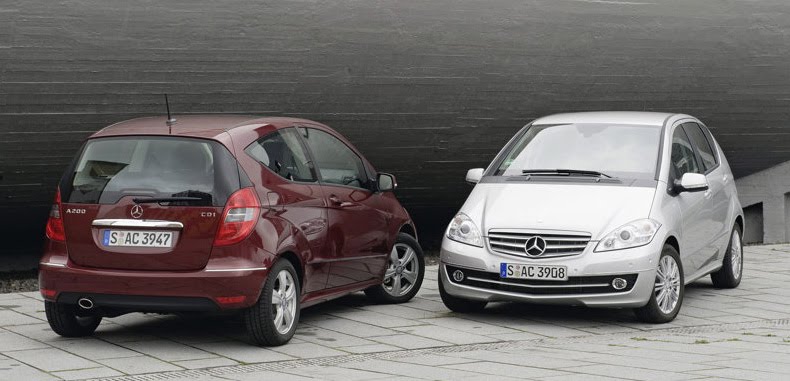
Mercedes A-Class Coupe 2009


The Mercedes-Benz A-Class is among the bestsellers in the Mercedes-Benz passenger car range. Now the latest generation of this compact car is showing itself to be more youthful, attractive and environmentally compatible than ever before. This is ensured by a completely revised design, high-grade appointments and new technical developments which further improve safety, comfort and economy. A convenient ECO start-stop function which reduces urban petrol consumption of these BlueEFFICIENCY vehicles by up to nine percent is now available for the high-volume models A 150 and A 170.

Lines: ELEGANCE and AVANTGARDE with an even more pronounced styling emphasis
Interior: upgraded with larger stowage compartments and new fabrics
Mercedes designers paid particular attention to enhanced value when redesigning the interior, choosing new, high-grade upholstery fabrics and door linings. In the ELEGANCE and AVANTGARDE lines the seats are upholstered in an attractive combination of ARTICO man-made leather and fabric, which is available in three colours.

Fuel economy: the A 160 CDI BlueEFFICIENCY consumes 4.5 litres
With fuel consumption figures between 4.9 and 8.1 litres per 100 kilometres, the new-generation A-Class is a model of fuel economy. The sum of these measures achieves a fuel saving of 0.4 litres, which means that the A 160 CDI BlueEFFICIENCY has an NEDC consumption of just 4.5 litres per 100 kilometres. As a result the CO2 emissions of the 60 kW/82 hp Coupé are 119 grams per kilometre.

The BlueEFFICIENCY is an aerodynamically optimised radiator grille. This has a closed-off interior face to reduce the airflow to the engine, though the CDI engine is still cooled effectively at all times. The suspension has also been lowered by ten millimetres to reduce the drag coefficient even further.
Start-stop function: the engine switches off automatically when idling
In the case of the petrol engines, Mercedes engineers have achieved NEDC fuel savings of up to 0.4 litres per 100 kilometres with a newly developed ECO start-stop function. From autumn 2008 this system will be available for the high-volume models A 150 and A 170 on request. It automatically switches off the engine when the driver shifts the manual transmission to neutral at a low speed while applying the brakes. If the conditions for engine switch-off are met, the driver is informed by a special display in the instrument cluster.

Economy: nine percent lower fuel consumption in city traffic
With the ECO start-stop function the NEDC fuel consumption is reduced by a further 6.5 percent or so. The A 150 BlueEFFICIENCY (70 kW/95 hp) absolves a measured test journey with a fuel consumption of 5.8 litres per 100 kilometres, which corresponds to 139 grams of carbon dioxide per kilometre.

Ecology: the Mercedes-Benz A-Class is the first compact car with an environmental certificate
Practical trials such as this are of immense importance to Mercedes-Benz when it comes to evaluating new technologies. The environmental compatibility of vehicles is not only assessed on the basis of standardised emissions and fuel consumption measurement, but also taking into account the entire vehicle lifecycle - from production and many years of operation to eventual recycling and disposal. An analysis of more than 40,000 individual processes provides an overall picture and enables the development work to be objectively assessed.

Safety: flashing brake lights warn following traffic
The adaptive brake light introduces technology from the luxury class into the compact segment, which therefore benefits from a further accident prevention system as a standard feature. Under emergency braking from a speed exceeding 50 km/h, the brake lights flash rapidly to warn following traffic, enabling drivers to respond quicker and prevent a collision.

Parking assist: ultrasound and electric steering for easier parking
Once a suitable parking space has been found, an arrow appears in the display to inform the driver on which side of the road the parking space is located. If he engages reverse gear, acknowledges the display message and accelerates, active parking assist takes over the steering and automatically manoeuvres the car into the parking space. The driver only needs to accelerate and operate the brakes; the ultrasonic sensors of the PARKTRONIC system assist him in this by keeping him informed about the distance to the vehicle in front of and behind the Mercedes-Benz A-Class.

Active parking assist uses a total of ten ultrasonic sensors in the front and rear bumpers, as well as an electronic control unit which processes the sensor signals and calculates the best possible entry path into the parking space. This information is fed to the electromechanical power steering, whose electric motor performs the necessary steering movements of its own accord. The parking space only needs to be 1.30 metres longer than the Mercedes-Benz A-Class for this automatic parking procedure to take place - an indication of the great precision of this technology.

 
Used Car 2011 powered by blogger.com
Design by : Fashion